


The crisis has knocked on our door in 2020 and, unfortunately, it will certainly bring many companies down. But how to handle the crisis on a par and even come out of it as a winner? In this article, we’ll go through concrete steps on how to not only avoid this situation, but also use it as an opportunity for development.
Let’s define: A crisis is a high-impact event that threatens the viability of an organization. During this period, a firm’s management is forced to make quick decisions that determine the short- and long-term future of the firm. However, inaction, lack of response and failure to adapt can lead a firm to problems, even insolvency. A crisis is actually a fundamental change in the variables or rules of the game that is called the market economy.
There are other ways to look at the crisis. Like business itself, crisis is an adventure that offers opportunities. Even many of the changes that take place in a firm during a crisis (if the firm responds) would have occurred anyway, just in a different timeframe. To better organize the activities that a firm must do in a crisis situation, it is necessary to stick to the three phases of crisis management.
Stages of crisis management on the unit:
- Preparing a quick plan
- Implementation and control
- Adaptation and victory
Phase 1: Preparation of a quick plan
Primarily, it is necessary to find out what economic effect the crisis situation may have on my company. It is best to prepare several scenarios so that you can orient yourself and know exactly how to proceed in better, worse, bad and liquidation “scenarios”.
Start with a financial plan:
- What financial impact can a crisis have on my business?
- What is the minimum revenue that my business must have to survive?
- How long can I survive with my reserve?
- How will I plan the company’s finances if the crisis lasts x months?
- What can I do if I run out of liquid money (cash and bank account)?
Continue with the organizational plan:
- Who is responsible for the implementation of activities during the crisis?
- Do I have to make redundancies?
- Do I have to change jobs or job titles?
- How will employee roles change in the company?
- Which staff activities will be prioritised and which will not?
Reinvent the way things work, not only for your organisation, but also for your clients, partners and suppliers. For example, during the quarantine, restaurant customers had to get used to the lunch ordering and delivery system, as it was not possible to eat indoors. Restaurants that wanted to survive needed to navigate their communications to their customers: what number to call, where to come for lunch, what the menu was today and other details for them.
Since time plays against you during a crisis, divide your actions into three categories:
- Priority items (things you urgently need to address)
- Setting up the system for the next weeks (medium-term plan of a week to 3 months)
- Long-term plan (How to transform your business for the long term by transforming into the digital world)
Phase 2: Implementation and control
Every company has costs that it could minimize. A good crisis manager should soberly analyze and classify all costs:
- Vital
- Needed
- Desirable
- Irrelevant
When minimizing costs, it is important to remember that the welfare of the company is above the welfare of management and employees. Because without the well-being of the firm, neither management nor employees will be needed. Also, the firm can find employees easier than the owner or management in times of crisis. The firm’s system must be adaptable to sudden changes in conditions.
Map out all products and services:
- Which of your products/services…
- …people need most at this time?
- …can they be digitised (e.g. ordered online)?
- …need to be strengthened in terms of marketing?
Phase 3: Adapt and Win
There have been breakthroughs in certain periods of human development that have moved us forward. At some point in time it was the transition from manual production to the introduction of machines, i.e. the system increased its efficiency and value-adding capacity. What this crisis proves once again is that the age of digitisation and digital transformation is here. Companies that already had active digital channels were better prepared for this period and were able to respond more effectively. However, those that do not get on board the digitalisation train have a reduced chance of prosperity and survival in the long term.
Start thinking about your company’s digital transition, after all, it’s better late than never. Ask:
- How do you digitize your products and services to minimize physical contact with customers?
- How to digitize processes in a company to make the communication system faster and more efficient?
- How to digitize sales?
- How do I make my products known digitally and create digital sales reps?
- How to communicate the benefits of my products and services digitally?
Why say yes to digital transformation?
- Sooner or later, the crisis will end. But customers won’t stop spending time in the online world.
- Digital transformation does not depend on location. You no longer need to be attached to an address, digital allows your business to expand location and in some cases sell anywhere.
- Digital transformation optimises costs.
- Digital transformation minimizes errors.
“Online marketing is not primarily a cost. It is an investment in future revenue. It’s through this marketing that you’ll be the first one your customers come to. “
Your competition has probably already turned off their advertising. What does this mean for you? That the price of online advertising space is lower than usual. It’s a good time to be in digital.
Finally, how did we handle the crisis with flying colours?
- We increased advertising budgets 3-fold
- We increased the number of online meetings with clients by 200%
- We have opened 3 new regions
This ensured that 5 months after the first wave of the crisis we were already 150% higher in sales than before the crisis.
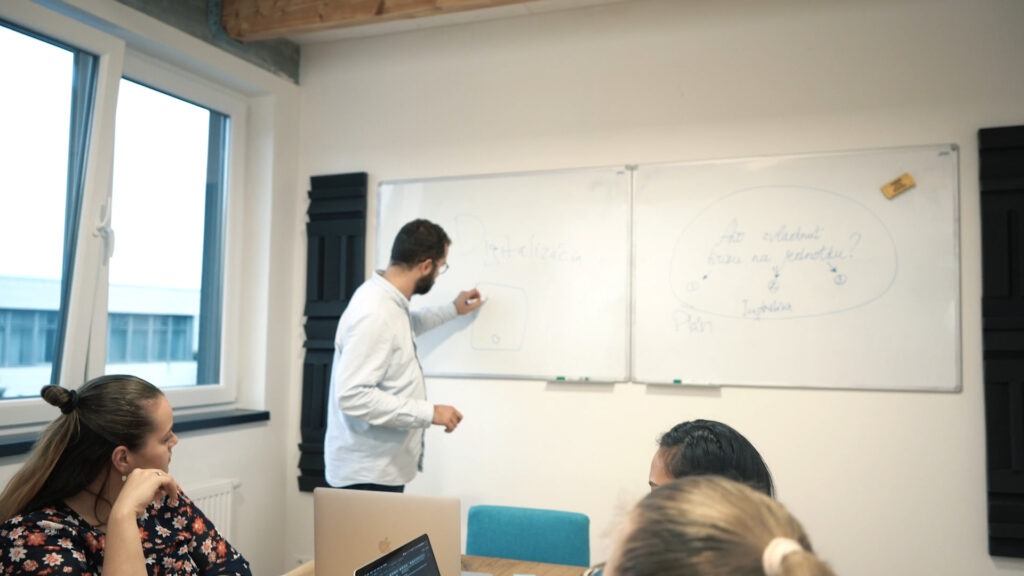
Handle a crisis better than your competitors and watch a free 50-minute video with a deeper explanation of “How to handle a crisis on a scale of one” at www.prognessa.com/academy/zvladni-krizu


